
IEA‐EBC Annex 94 subtask updates
Subtask 1
By Mark Collett & Liesje van Gelder
The IEA-EBC Annex 94 Stakeholder Survey “How Do We Measure Up?” closed on the 20th May after collecting over 280 responses from 20 different countries and across a broad range of professions. We would like to thank readers of the DYNASTEE newsletter who completed the survey. Subtask 1 will now be focused on the analysis and write up of the responses to understand how measurements of building energy performance are practically being used by industry.

Subtask 2
By Katia Ritosa & María José Jiménez
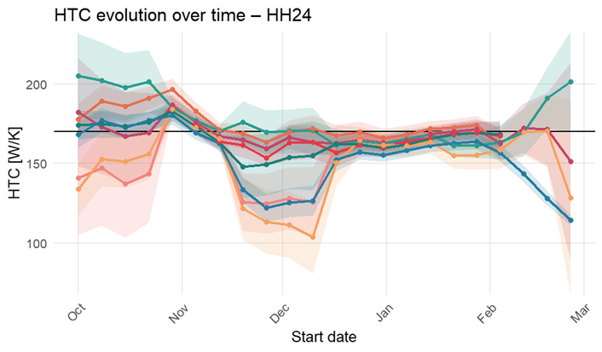
The activities of Subtask 2 currently focus on investigating time as a critical variable in HTC estimation procedures. Recent studies indicate that HTC estimates exhibit seasonal variability, generally linked to underlying measurement conditions, with differences also arising from the choice of applied methods. Consequently, one of the key objectives of ST2 is to disentangle genuine variability in HTC from the uncertainty introduced by differing estimation methodologies. In parallel, ST2 is systematically evaluating the influence of analysis-related choices, including period selection, measurement frequency, and signal processing techniques, on the resulting HTC estimates. The Figure below illustrates the temporal evolution of HTC over a single heating season, as modelled by multiple participants (different colours) applying different data filtering approaches, all using the Siviour model.
Subtask 3
By Sarah Juricic & Frances Hollick
What would future validation of HTC measurement methods look like?
Past benchmark tests comparing different HTC measurement methods have shown that test results don’t systematically align. While slightly variable results may be expected, no consensus has been found on assessing and comparing unaligned test results. In addition, methods, whether they be from the industry or from academia, have been individually validated against heterogeneous experiences on different building types which prevents straightforward comparison.
Subtask 3 aims therefore at defining, providing and testing a common framework to compare and validate HTC measurement methods. First, a glossary of HTC, uncertainty and validation terms has been completed as to spread a common vocabulary among researchers and industry. A template has also been finalised to provide a common structure of test reporting and is currently being applied to existing commercialised methods. Three scientific papers are actively in preparation with (1) a longitudinal review of validation practices in our field and beyond, (2) a review and classification of sources of uncertainty and (3) a paper examining the critical issue of the existence and definition of an HTC ground truth. Next steps include developing a library of use cases and exploring the feasibility of validation of an HTC measurement method based on its accuracy to predicting energy use.
Subtask 4
By Grant Henshaw & Richard Jack
Subtask 4 has developed a set of building pathology flowcharts that will be iteratively refined throughout the Annex to form a standardised diagnostic method. These flowcharts are designed to underpin a structured yet practical approach to diagnosing building performance issues, supporting users in identifying performance concerns, selecting appropriate diagnostic techniques, interpreting results, and ultimately informing remedial design. To develop the framework, the team has compiled a comprehensive catalogue of current building diagnostic methods. This includes key information on each method’s outputs, accuracy, duration, and level of invasiveness, providing a consistent evidence base for structuring diagnostic decision pathways.
The current flowcharts cover four main domains: thermal performance, moisture and indoor air quality, overheating risk, and building system performance. Each diagnostic pathway is driven by defined threshold values; when these thresholds are exceeded, they indicate potential performance deficiencies and trigger appropriate in-situ diagnostic investigations to quantify and confirm issues. It is imagined that the threshold values could be set regionally to fit with local regulations, guidelines, and contexts. The diagnostic process is structured into five stages: survey, remote investigation, detailed investigation, remedial action, evaluation, and prevention. A cross-cutting requirement has also been identified to systematically capture and share learning across both research and industry, ensuring continuous improvement of methods and outcomes.
The next phase of work will focus on testing the practicality of the flowchart approach in both controlled test facilities and real-world buildings. Field trials in occupied dwellings are being planned for later in 2026, in close collaboration with Subtask 2, with the intention of sharing test dwellings so that whole-house HTC measurements and fabric pathology diagnostics can be conducted concurrently in the same properties. This coordinated approach will maximise the value of each field visit and generate paired datasets to support the verification and validation work of Subtask 3. The trials will also assess how effectively the diagnostic process supports decision-making in practice and help identify enabling tools. A key emerging concept is the development of an AI-informed chatbot to support building professionals in applying the methodology. The Annex plans to develop and trial a beta version of this tool as part of its ongoing work programme.
Subtask 5
By Matthew Li & Joshua Cooper
Activities in subtask 5 have focused on identifying the data requirements of activities planned in subtasks 2–4, the extent to which these may be met by existing datasets, and the capacity of participants to procure or generate additional datasets to satisfy remaining needs. In parallel, work is underway to review and establish best practice for gathering, curating and disseminating in-use building performance datasets. The findings will feed into plans for collating sufficient data to both serve the needs of the Annex and to provide a legacy dataset for future use in validation and verification of building energy performance measurement techniques.